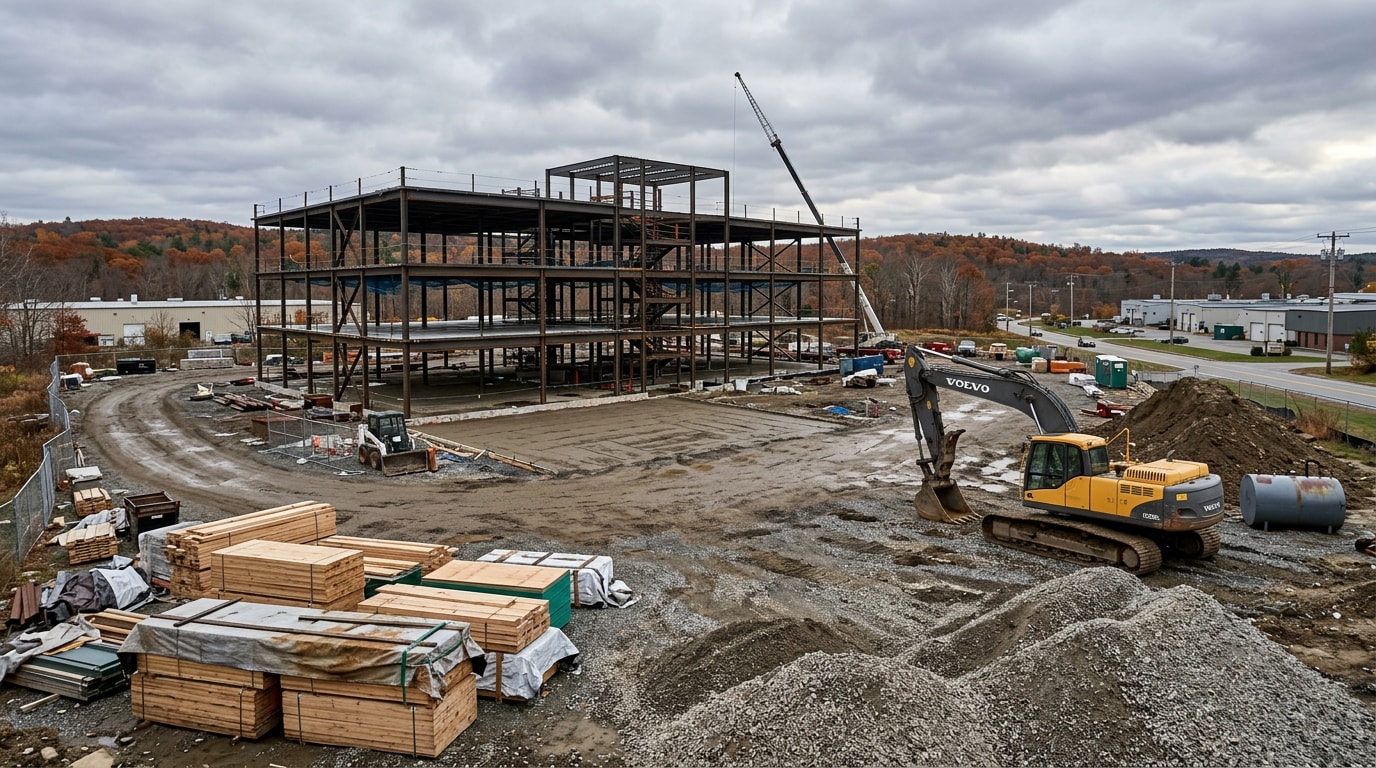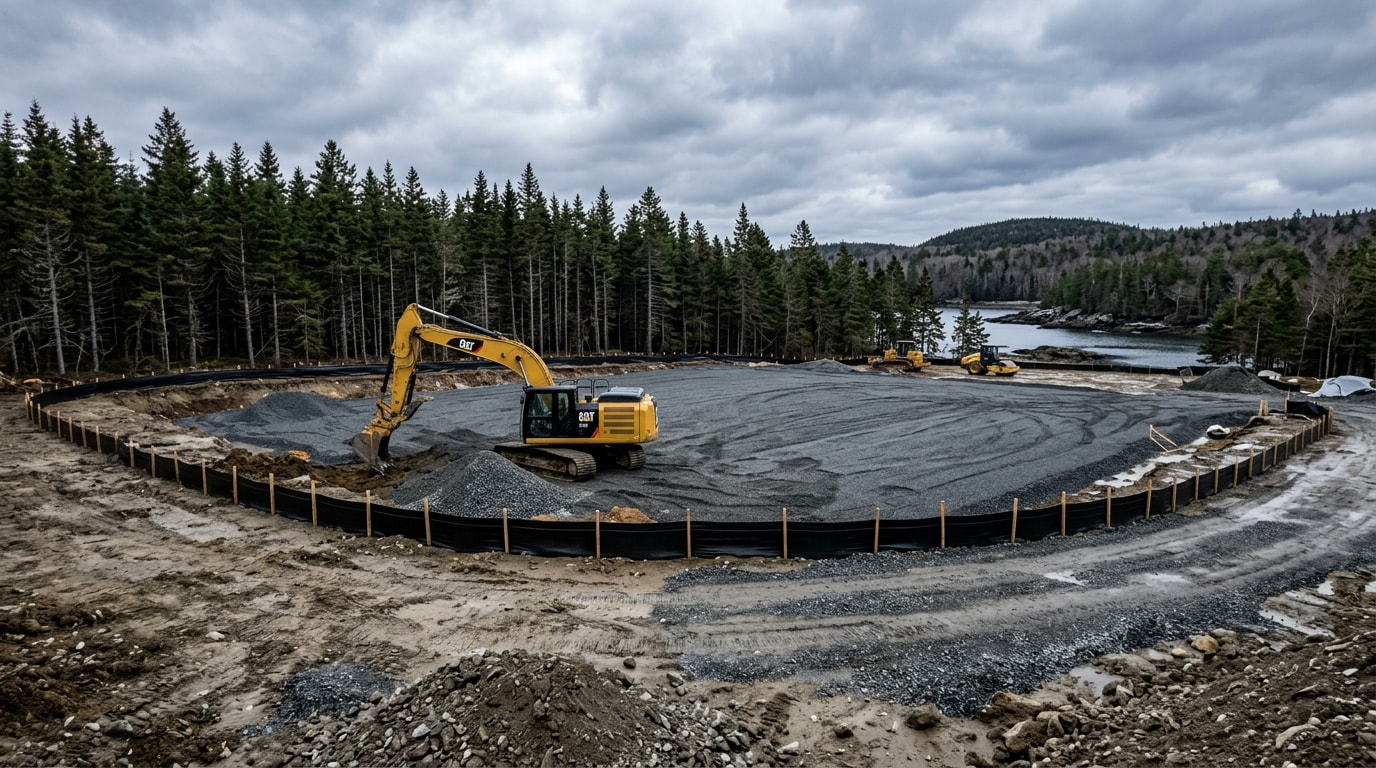
Commercial general contracting in Ellsworth, ME starts well before a building takes shape; it starts with what's under the ground. Frost depth, ledge, drainage, and septic capacity decide whether a commercial project opens on time or sits delayed through a Maine winter. This guide covers the site work, septic systems, and civil groundwork that make up commercial contracting in Hancock County, plus what it costs and who has to sign off on it.
At MPS LLC, we've graded building pads in July heat and raced to close a septic trench before November frost. Downeast scheduling leaves little room for guesswork, and that shapes everything below.
What Commercial General Contracting Covers On The Ground
"Commercial general contracting" means different things depending on who's doing it. A vertical builder frames walls, runs electrical, and hangs drywall. A site and civil contractor, the role MPS LLC fills, handles everything that happens before and around the building: excavation, grading, drainage, septic systems, erosion control, and the material supply that keeps a job moving.
Both roles matter on a commercial project, and they need to coordinate closely. A building GC can't pour a slab on unstable fill, and a retail tenant can't open without a code-compliant septic system or stormwater plan in place.
In Ellsworth specifically, the City's Unified Development Ordinance triggers site development plan review for most non-residential work. Projects with 5,000 square feet or more of new non-residential floor area in a five-year span, or that create 10,000 square feet or more of impervious surface, need Planning Board or Code Enforcement Officer sign-off before a building permit is issued. The Ellsworth Code Enforcement Department reviews these applications and can tell you early which tier your project falls into.
Site Preparation And Excavation: Where Every Commercial Project Starts
Before footings get poured, the site has to be cleared, graded, and compacted to bear the load of the finished building and its traffic. In Hancock County, that usually means dealing with ledge, a high water table, or clay pockets that don't drain the way a spec sheet assumes.
A typical site prep sequence looks like this:
- Clearing and stripping topsoil
- Rough and finish grading to design elevations
- Compaction testing on structural fill
- Gravel base installation for roads, parking, and building pads
- Utility trenching and backfill

We cover this scope through site preparation equipment, excavation services, and gravel delivery and installation. For larger pours or phased builds, material delivery keeps aggregate, fill, and base material arriving on the schedule the GC needs, not whenever a supplier gets around to it.
Commercial Septic Systems: Design, Prep, And Installation
Commercial septic work is not scaled-up residential work. Maine's Subsurface Wastewater Disposal Rules (10-144 CMR Chapter 241) set design flow requirements by facility type, meaning a restaurant, office, or retail space each calculate differently than a single-family home. The rules were last revised in 2023, and any design permitted after that date has to meet the updated standard, including added riser requirements on septic and holding tanks.
A Maine-licensed site evaluator has to test the soil and stamp the design before a local plumbing inspector will issue a permit. Full details on current design flow tables and the 2023 revisions are published by the Maine CDC's Subsurface Wastewater Disposal Rules page.
Our scope on commercial septic projects includes:
- Septic System Design Consultation
- Septic Site Preparation
- Septic System Installation
- Septic Drain Field Installation
If you're not sure whether an existing system can support a business expansion, that's a design consultation conversation before it's a permit conversation. Guessing on design flow is how commercial projects fail inspection and lose weeks.
Drainage, Erosion Control, And Hardscape For Commercial Sites
Parking lots, loading docks, and building perimeters all concentrate water in ways a lawn never does. Without a real drainage plan, that water ends up in a basement, a neighboring property, or the state's stormwater violation file.

We handle the civil side of this scope through:
- Drainage System Installation
- Erosion Control Solutions
- Retaining Wall Construction
- Stone Walkway Installation
- Paver Patio Installation
Sloped lots along the coast or near Hancock County's ponds and streams often need erosion control worked into the grading plan from day one, not added after a washout.
Keeping Commercial Grounds Maintained After Construction
Construction ends; the grounds don't stop needing attention. Overgrown sightlines at a parking lot entrance, a mulch bed that's gone to weeds, or leaves clogging a catch basin all become liability issues for a commercial property owner, not just curb-appeal ones.
Our landscape maintenance scope for commercial clients covers lawn mowing, spring cleanup, fall cleanup, mulch installation, and ongoing landscape maintenance. Rolling this into the same contractor who built the site means one point of contact instead of three.
Permits And Code: What Ellsworth Actually Requires
Ellsworth's site plan review thresholds catch more projects than most owners expect. Under the city's Unified Development Ordinance, site development plan approval is required for:
| Trigger | Threshold |
|---|---|
| New or expanded non-residential floor area | 5,000 sq ft or more in any 5-year period |
| New impervious surface | 10,000 sq ft or more |
| Commercial earth moving or extraction | 20,000 sq ft or more of disturbed area |
| Location in the Commerce Park zoning district | Any size, no minimum |
Any one of these pulls a project into Planning Board or Code Enforcement Officer review before a building permit can be issued, according to the City of Ellsworth's current Site Plan Review ordinance. Commercial buildings also have to meet accessibility standards under the ADA. The U.S. Department of Justice's ADA primer for small businesses lays out which construction deadlines and design standards apply to new builds versus alterations.
On the jobsite itself, OSHA's construction standards govern fall protection, trenching, and excavation safety, regardless of project size. OSHA's construction industry compliance page is the authoritative source contractors and owners should check for current requirements.
One piece of context worth knowing: Maine still has no state-level license for general contractors, commercial or residential. A bill that would have created one, LD 1226, passed both the House and Senate in 2025 but died on adjournment in April 2026 when lawmakers couldn't agree on funding. For now, Maine's existing written-contract rule still applies: any home construction contract over $3,000 needs specific written terms, and commercial contracts of any size should carry the same discipline even though the statute technically targets residential work.
When To Bring In A Site And Civil Contractor Before Your GC Breaks Ground
Not every commercial project needs a dedicated site contractor from day one, but a few situations make it worth calling early:
- You're planning new construction and haven't had the site evaluated for drainage, soil, or septic capacity yet
- An existing commercial septic system needs to support a business expansion or change of use
- A parking lot or loading area floods, erodes, or ices over in ways that point to a drainage problem, not just bad luck
- Your building GC has asked for a site subcontractor and you want someone who already knows Ellsworth's permitting process
Get a free estimate before you're locked into a construction timeline. Site and septic issues are far cheaper to catch in the planning phase than after a foundation is poured.
How To Choose A Site Contractor For A Commercial Project In Hancock County
A few checks matter more than a polished website:
- Insurance verification. Call the contractor's insurer directly to confirm general liability and workers' comp are active, not just listed on a bid sheet.
- Local permitting experience. A contractor who's filed site plans with Ellsworth's Code Enforcement Office before will spot red flags in your project before the city does.
- Equipment capacity. Ledge removal, large-scale grading, and septic installation each need different equipment on hand, not rented after the fact.
- References from similar commercial work, not just residential landscaping jobs.
We serve commercial and municipal clients across Ellsworth, Bar Harbor, Bucksport, Castine, Orono, Bangor, Searsport, and the rest of Hancock County.
Contract Types: Cost-Plus vs. Guaranteed Maximum Price
Most commercial site and construction contracts fall into one of two structures. Knowing the difference before you sign protects your budget more than chasing the lowest bid does.
| Contract Type | How Pricing Works | Best For |
|---|---|---|
| Cost-Plus | Owner pays actual costs plus an agreed fee or percentage | Projects where scope may change, like unknown soil conditions |
| Guaranteed Maximum Price (GMP) | Contractor caps the total price; overruns are generally absorbed by the contractor | Owners who need budget certainty for financing or leasing |
Cost-plus gives flexibility when site conditions are uncertain, which is common on ledge-heavy or wetland-adjacent Hancock County lots. GMP gives predictability but usually requires a more thorough site evaluation upfront so the contractor can price the risk accurately.
FAQ
What does commercial general contracting actually include in Ellsworth?
It covers site preparation, excavation, grading, drainage, septic design and installation, erosion control, and material supply, in addition to any building construction. Site work and vertical construction often involve separate contractors working on the same project.
Do I need a permit for commercial site work in Ellsworth?
Most non-residential projects do. Ellsworth requires site development plan approval for new non-residential floor area of 5,000 square feet or more, 10,000 square feet or more of new impervious surface, or any project in the Commerce Park zoning district. Check with the Code Enforcement Office before you finalize a design.
Is a general contractor license required in Maine?
No. Maine has no statewide license for general contractors. A 2025 bill, LD 1226, would have created one starting in 2027, but it died on adjournment in April 2026 without funding. Written contracts over $3,000 are still legally required regardless.
How is a commercial septic system different from a residential one?
Design flow calculations differ by facility type under Maine's Subsurface Wastewater Disposal Rules. A restaurant, office, and retail space each require different sizing even on the same lot. A licensed site evaluator has to stamp the design before a permit is issued.
How long does commercial site prep take in Hancock County?
It depends on soil conditions, ledge, and the season. Winter frost and spring mud season both shrink the usable building window, so projects started in late fall often need to pause until the ground firms up in spring.
Should I hire one contractor for both site work and the building?
Not necessarily. Many commercial projects use a dedicated site and civil contractor for groundwork, septic, and drainage, paired with a separate building GC for the structure. The key is making sure both coordinate closely on schedule and grading tolerances.