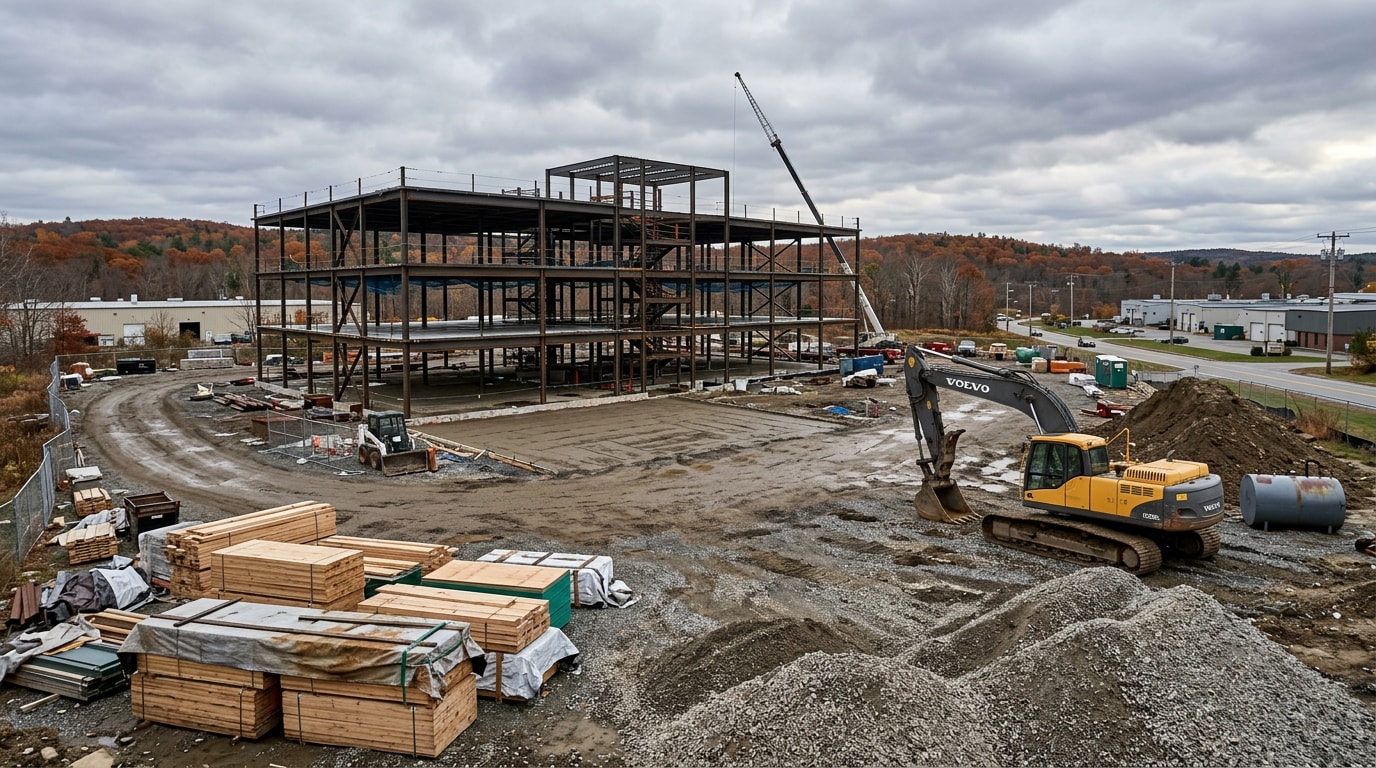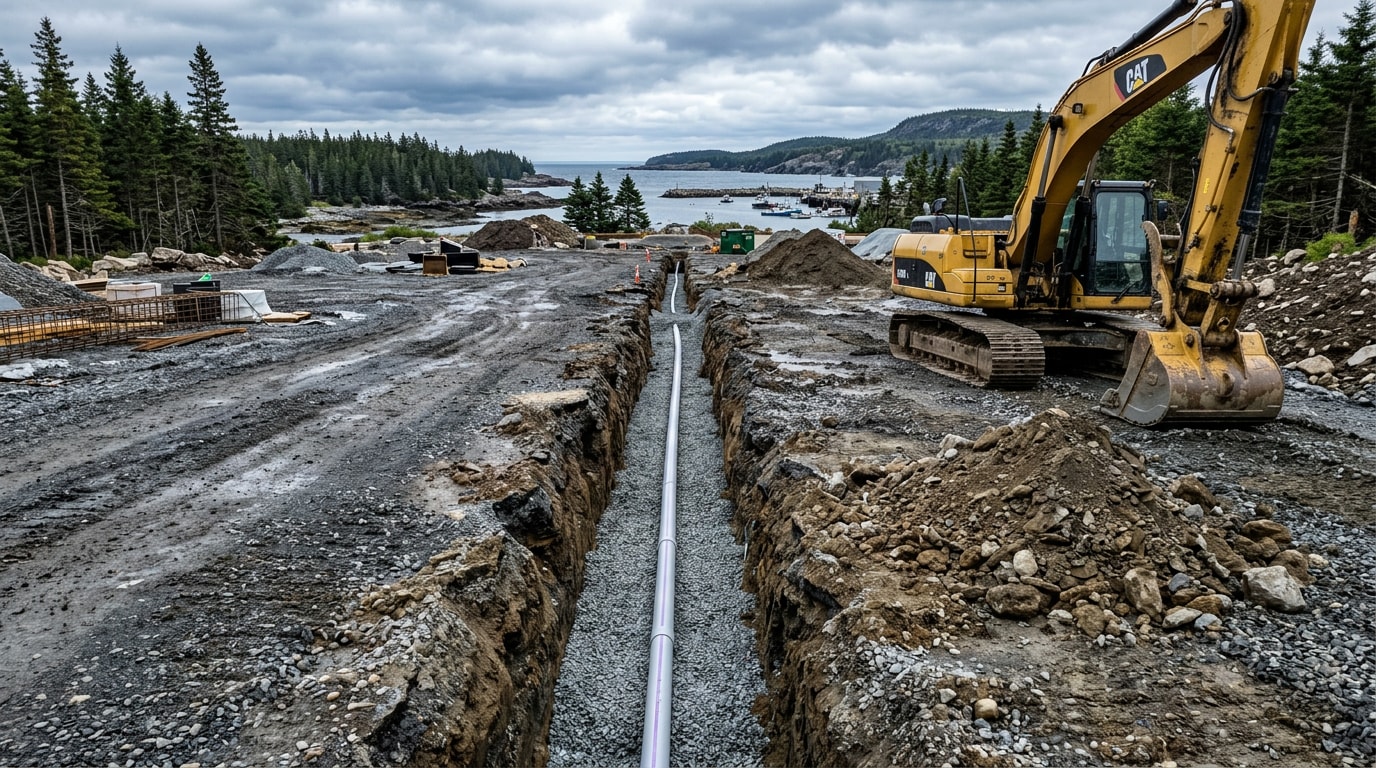
Every electrical construction project in Castine starts underground, not at the panel. Before a licensed electrician can pull wire, set a meter base, or land a generator transfer switch, someone has to trench the conduit path, prep a stable pad, and get the site ready to pass inspection. MPS LLC is the site-work and construction equipment company Castine contractors, builders, and property owners call on to handle that half of the job, on schedule and built to hold up on a working waterfront peninsula.
Why Electrical Construction Starts With the Ground, Not the Wire
Conduit has to sit on compacted, well-drained base material or it heaves, cracks, and fails inspection the first freeze-thaw cycle. Generator pads need level, load-bearing ground. Underground service entrances need a trench cut to the right depth and backfilled with the right material around the conductor.
On the Castine peninsula, shallow ledge and a high water table show up often once excavation starts for conduit runs or equipment pads. That changes the plan for trench depth, bedding material, and drainage before an electrician ever shows up to do the trade work.
This is the site-work layer of an electrical construction project, and it's the piece most homeowners never think about until a permit gets held up or a pad settles unevenly after the first winter.

What MPS LLC Handles on Electrical Construction Projects
We don't hold the state electrical license, your licensed electrician does. What we handle is everything that has to happen so their work goes in right the first time:
- Trenching and excavation for underground conduit, service entrances, and utility runs through our excavation services
- Site preparation for transformer pads, generator pads, and equipment enclosures via site preparation equipment
- Gravel base and compaction under pads and conduit beds, through gravel delivery and installation
- Material delivery for bedding sand, crushed stone, and backfill scheduled around your electrician's timeline, through material delivery
- Drainage work around pads and panels so standing water never becomes a corrosion or safety problem, through drainage system installation
All of that work follows the safety framework set out in the National Electrical Code, the NFPA 70 standard adopted across Maine for safe electrical installation and inspection.
Generator Pads and Standby Power Site Prep
Castine loses power during nor'easters and ice storms like the rest of the Maine coast. Standby generators have become one of the most common electrical construction requests we support, and the generator itself is only part of the project.
A standby system needs a level, properly drained pad, correct clearances from the structure, and in many cases a dedicated site path for fuel line or conduit routing. Generator performance and installation requirements fall under NFPA 110, the national standard for emergency and standby power systems. We build the pad and handle the excavation; your electrician handles the transfer switch and connection.
Coordinating With Licensed Electricians and the Castine Code Office
Most of our electrical construction work happens alongside a general contractor or a licensed electrician, not as a standalone call. We line up trench and pad work with their rough-in schedule, coordinate inspection timing with the local code office, and stay out of the way of the trade work that requires a state license.
That coordination matters more in Maine than in most states. Maine does not currently license or regulate general contractors at the state level. In Maine, general contractors, and trades such as roofing and framing, are not licensed or regulated. Electricians are the exception: they're licensed through the state's Electricians' Examining Board, and that license is what actually governs who can legally do the wiring, panel, and connection work on your project.
A new law is changing part of that picture. Starting January 1, 2027, Maine's LD 1226 will require a state license for residential general contractors on jobs over $15,000 or jobs involving two or more licensed trades, through a newly created Residential Construction Board. Beginning January 1, 2027, a residential general contractor must be licensed under this chapter to perform residential construction with a contract price that exceeds $15,000, or that involves two or more professionals licensed under this Title. Electricians working within their own license are exempt from that new requirement. If your project is in planning now for 2027, that timeline is worth asking your contractor about directly.
How to Vet a Site-Work Partner for an Electrical Construction Project
Not every excavation or landscaping crew is set up to work around an electrical rough-in schedule. Before you hire, ask:
- Have they worked trenching and pad projects alongside licensed electricians before, not just standalone landscaping jobs?
- Do they know the difference between standard backfill and the bedding material a conduit run needs?
- Can they hit a specific date for pad completion so your electrician isn't standing around waiting?
- Will they coordinate directly with your general contractor or electrician, or do you have to manage that handoff yourself?
- Is the electrician on the job actually licensed? You can verify any Maine electrician's license directly through the state board before work starts.
Get more than one quote, compare scope rather than just the bottom-line number, and read what's actually included before signing anything.
Site Work vs. Electrical Trade Work: Who Does What
| Project Phase | Handled By | Example Tasks |
|---|---|---|
| Excavation & trenching | Site-work contractor (MPS LLC) | Conduit trenches, generator pad cuts, utility runs |
| Base prep & drainage | Site-work contractor (MPS LLC) | Gravel base, compaction, drainage around pads |
| Material supply | Construction equipment supplier (MPS LLC) | Bedding sand, crushed stone, backfill delivery |
| Wiring, panels, connections | Licensed electrician | Service entrance, panel, generator transfer switch |
| Permits & electrical inspection | Licensed electrician + code office | NEC-compliant rough-in and final inspection |
Why Getting the Site Work Right Saves Time and Money
A trench cut too shallow, a pad poured without drainage, or backfill that wasn't compacted correctly all turn into change orders once an electrician or inspector finds the problem mid-project. Handling the planning, excavation, and material delivery as one coordinated process, instead of a patchwork of separate calls, is what keeps an electrical construction project moving instead of stalling at the inspection stage.
We also handle septic site preparation on the same lots where underground electrical and utility trenching overlap, which is common on older Castine properties where the septic system, well line, and electrical service all cross the same stretch of yard.

Areas We Serve Around Castine
MPS LLC works throughout the Castine peninsula and the surrounding Hancock County towns, including:
- Castine, ME
- Bucksport, ME
- Searsport, ME
- Ellsworth, ME
- Bar Harbor, ME
- Orono, ME
- Bangor, ME
- Hancock County, ME
If your electrical construction project involves site work anywhere on that list, including conduit trenching, generator pads, or utility-line excavation tied to a new build, see how we handled the outside-plant site work for a recent Bangor-area project for a look at how the process runs from permitting through closeout.
About MPS LLC
MPS LLC is a Hancock County site-work, excavation, and construction equipment company. We support general contractors, electricians, and property owners on the ground-level work that every electrical construction, generator, and new-build project depends on, from trench to pad to final grade. Visit our homepage to see the full range of site work, septic, and landscaping services we handle, or get a free estimate for your project.
FAQ
What's the difference between an electrical contractor and a site-work contractor?
An electrical contractor is licensed to design, wire, and connect electrical systems. A site-work contractor like MPS LLC handles the excavation, trenching, pad preparation, and material delivery that has to happen before and alongside that electrical work. On most Castine projects, both are on-site at different stages.
Does Maine require a general contractor license?
Not yet. In Maine, general contractors, and trades such as roofing and framing, are not licensed or regulated. That changes January 1, 2027, when a new state law requires licensing for residential contractors on projects over $15,000. Electricians remain separately licensed through the state's Electricians' Examining Board regardless of that change.
How do I verify an electrician's license in Maine?
Search the electrician's name or license number through Maine's Office of Professional and Occupational Regulation before signing a contract. That confirms the license is active and in good standing before any work starts.
Do you provide the electrical wiring yourselves?
No. MPS LLC handles the excavation, trenching, pad prep, and material delivery for electrical construction projects. The wiring, panel work, and connections are done by a licensed electrician, and we coordinate our schedule around theirs.
How much does site prep for a generator installation cost?
It depends on the pad size, excavation depth, soil conditions, and how far materials have to travel to the site. Contact us for a free estimate based on your specific property.
What happens if a trench isn't dug to code before an electrician arrives?
The electrician either has to re-dig it themselves at added cost or wait for it to be corrected, which delays the schedule. Getting trench depth, bedding, and backfill right the first time is the main reason to hire a site-work crew experienced with electrical construction projects specifically, not just general landscaping.