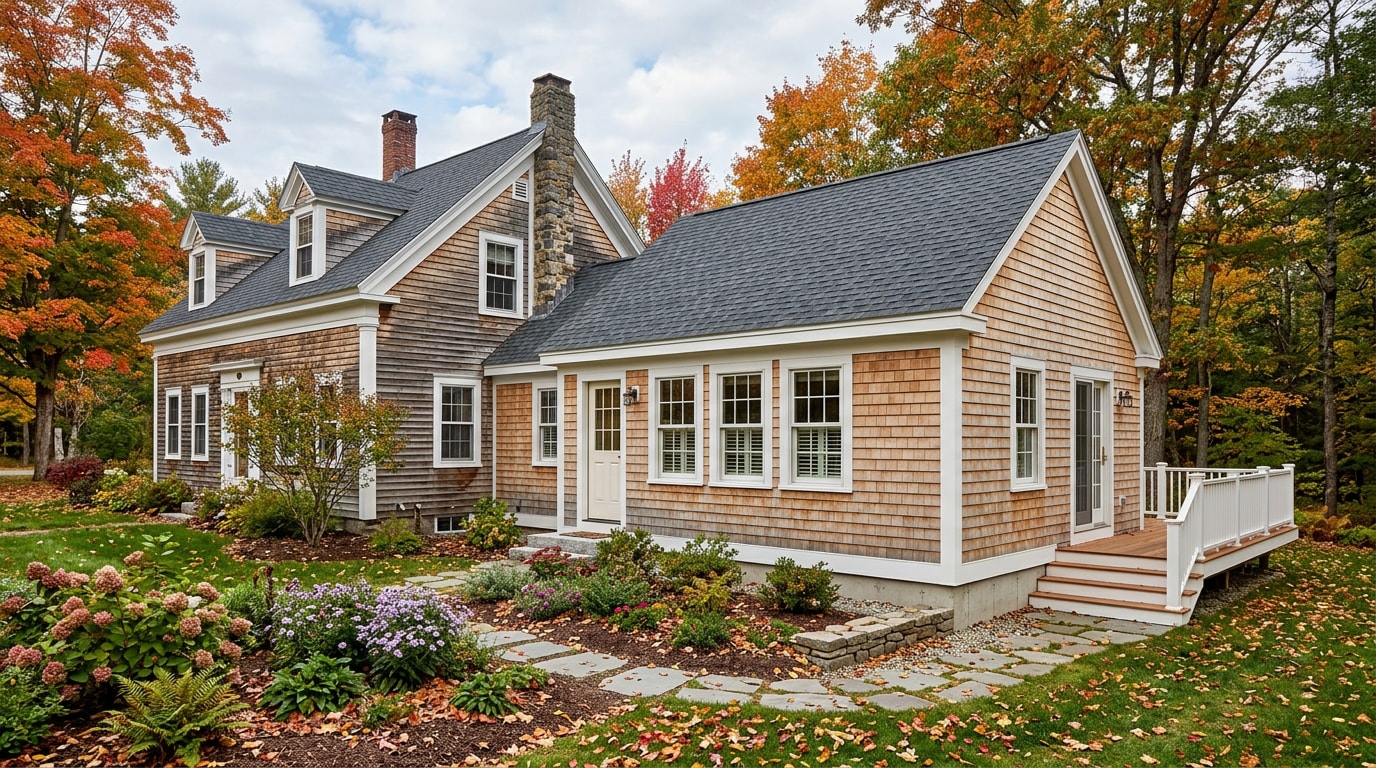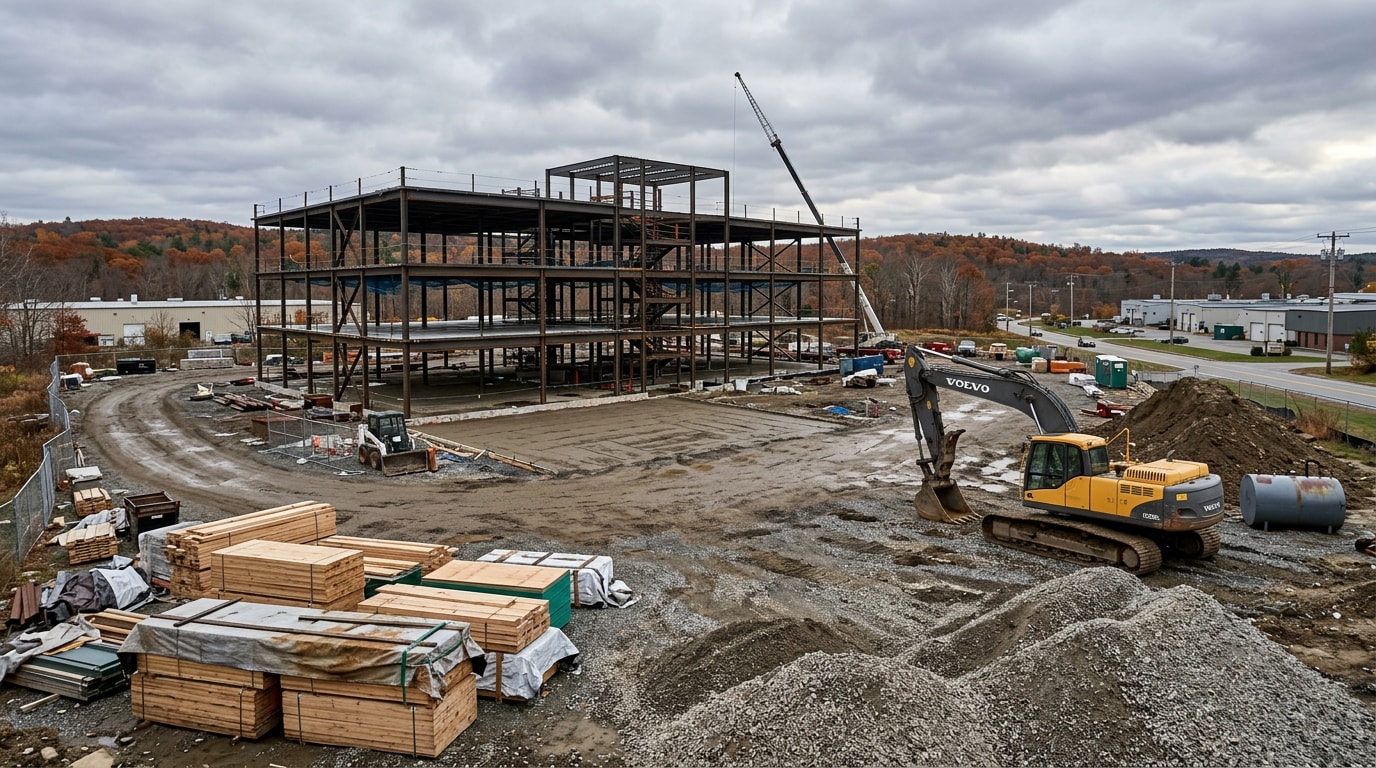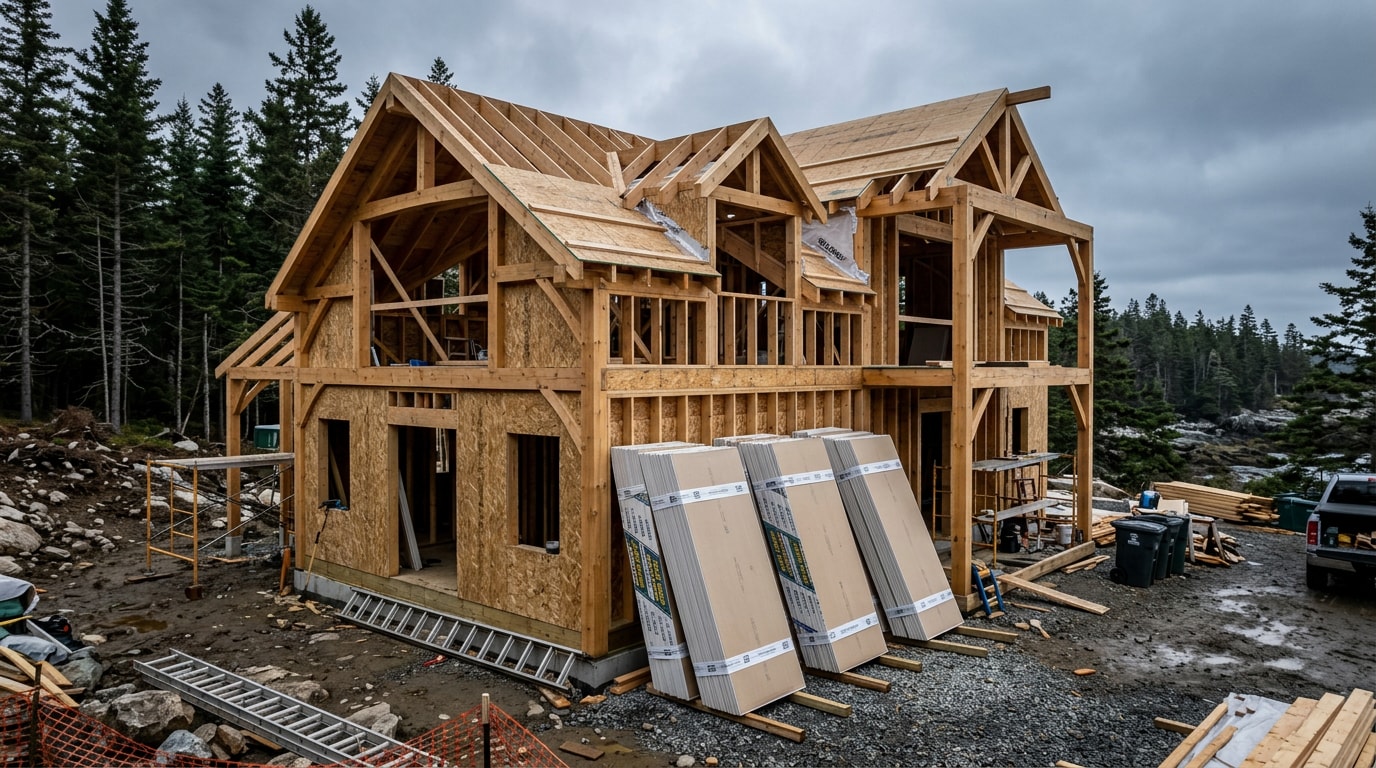
GWB in construction Hancock County, ME stands for gypsum wallboard, the technical term contractors use for drywall on blueprints and material schedules. If you've seen "GWB" called out on a spec sheet and wondered whether it's different from the drywall at the hardware store, it isn't. Here's what the term covers, which type your project actually needs, and what changes when the job site sits on a Hancock County peninsula or island.
What Does GWB Stand For?
GWB stands for Gypsum Wallboard. It's the same product most people call drywall, sheetrock, or gypsum board.
Architects and engineers default to "GWB" because it's the term used in construction documents, material schedules, and code references. On a job site, crews use all four names interchangeably without any confusion.
What Gypsum Wallboard Is Made Of
GWB consists of a gypsum plaster core sandwiched between two layers of heavy paper or fiberglass matting. Gypsum is a naturally occurring mineral, calcium sulfate dihydrate, mined and processed specifically for construction use.
Manufacturing is simple. Gypsum powder is mixed with water and additives, spread between paper layers, then cut into panels and dried until rigid. The result is a stable, paintable surface ready for taping and finishing once it's hung on framing.

GWB Types, Thickness, and Where Each One Belongs
Not every wall needs the same board. The type and thickness depend on the room, the fire rating required, and how much moisture that wall will see.
| Type | Typical Thickness | Best Use | Why It's Specified |
|---|---|---|---|
| Standard (regular) | 1/2 in | Dry interior walls, most living spaces | Lowest cost, fastest install |
| Type X (fire-rated) | 5/8 in | Garage separation walls, shared walls, rated ceilings | Slows heat transfer in tested assemblies |
| Moisture-resistant (green/purple board) | 1/2 in or 5/8 in | Bathrooms, basements, laundry rooms | Treated facings resist mold in damp spaces |
| Exterior gypsum sheathing | 1/2 in or 5/8 in | Underlayment beneath siding | Water-resistant core protects the wall assembly |
Multi-layer GWB installations also show up where extra soundproofing matters, like shared walls between units or a home theater.
Common Applications of GWB in Construction
GWB does more than cover studs. On a typical Hancock County build, you'll find it:
- Finishing partition walls and covering ceiling joists
- Forming fire-rated assemblies between garages, units, or stairwells
- Wrapping curved surfaces, using flexible gypsum board that bends where rigid plaster can't
- Backing tile in wet areas, paired with moisture-resistant board
If your project also involves new framing, our guide to residential framing contractors in Castine, ME covers how framing choices affect which GWB type and thickness your contractor specs later.
Exterior Gypsum Sheathing: GWB Outside the Wall
Exterior gypsum sheathing is a different product from interior GWB, built to sit under siding instead of behind paint. It attaches to exterior wall framing as an underlayment beneath wood, metal, vinyl, brick veneer, stucco, or shingle siding.
The Gypsum Association describes it as "a specialized performance panel consisting of a noncombustible, moisture-resistant core wrapped in glass mat facers" . That moisture resistance matters more here than in drier inland states. Coastal Hancock County sees wind-driven rain and salt-air humidity most of the year, and a water-resistant core is one line of defense before siding ever goes on.
Why GWB Still Wins Over Plaster and Alternatives
Cost is the obvious reason. GWB installation generally runs well below traditional wet plaster for comparable results, and it goes up faster, which matters during a short Maine building season.
Fire resistance is the second reason architects keep specifying it. Gypsum holds water molecules locked in its crystalline structure. When exposed to fire, that water releases as steam, which slows heat transfer through the wall. Code officials rely on tested assemblies, not general claims, to confirm a wall actually performs this way.
The International Building Code "contains the provisions and referenced standards that regulate the design, construction and quality of gypsum board" , and most gypsum board other than sheathing has to be installed according to referenced ASTM or Gypsum Association standards to count as code-compliant.
Maine builds fall under a statewide code too. Maine will begin adopting the 2021 ICC Model Codes beginning April 7, 2025 , which means the same IBC and IRC provisions governing GWB fire ratings and installation apply on a Hancock County job site as anywhere else using those model codes.
Sound insulation rounds out the list. Multi-layer GWB assemblies, sometimes paired with resilient channel, cut sound transfer between units or rooms far better than a single layer ever could.
GWB Thickness and Installation Basics
Thickness guidance is fairly consistent across the trade:
- Most interior walls use 1/2 inch board.
- Ceilings often step up to 5/8 inch to resist sagging over time.
- Fire-rated assemblies may require thicker panels or multiple layers stacked together, installed to match a tested design rather than swapped in freehand.
Installation comes down to two steps done well: cutting and fitting panels tight to the framing, then taping and finishing joints for a seamless surface. Skipping proper fastener spacing or using the wrong board in a rated wall is the most common way a rough-in fails inspection.

Getting GWB to a Hancock County Job Site
This is the part generic guides skip. Material availability and lead time change once you're building on a peninsula or island instead of a city lot.
We coordinate pallet deliveries of 1/2-inch and 5/8-inch GWB to job sites across the county, including Castine, Bar Harbor, and Bucksport. Narrow access roads, ferry schedules, and seasonal weight restrictions can turn what's a same-day delivery near Bangor into a two-day wait on the coast. Ordering board and fasteners a week ahead of the framing crew's finish date, rather than the day drywall starts, avoids most of that delay.
If you're scheduling a build anywhere in Hancock County, our material delivery service can line up GWB and other building materials around your framing timeline. Get a free estimate before your drywall crew is standing around waiting on board.
Common Misconceptions About GWB
- "Drywall and plaster are the same thing." They're not. Plaster is wet-applied in multiple coats over lath, a slow, skilled process. GWB arrives as pre-manufactured panels that only need joint finishing once hung.
- "GWB is fragile." Installed correctly, with proper fastening and jointing, it holds up for decades. Most damage traces back to poor installation, not the material itself.
- "GWB limits design options." Finished GWB can take on smooth skim coats, heavy texture, curves, or paint-ready flat finishes. The limitation is usually the installer's skill, not the board.
The Bottom Line
GWB is the standard material for interior walls and ceilings on nearly every Hancock County build, from a bathroom remodel to a full commercial fit-out. The type and thickness you need depends on the room, the fire rating required, and how much moisture that wall will see.
Reach out through our contact page to talk through material types, delivery timing, and what your specific project needs, or start at our homepage to see the full range of site work and material services we offer across the county.
This guide was prepared by the site-work and materials team at MPS LLC, a Hancock County contractor coordinating excavation, site prep, and construction material delivery, including GWB, for builds from Castine to Bucksport.
FAQ
What Does GWB Stand For in Construction Drawings?
GWB stands for Gypsum Wallboard. It shows up on construction drawings and material schedules instead of the common names drywall or sheetrock.
Is GWB the Same as Drywall?
Yes. Drywall is the everyday term. GWB is the abbreviation used in formal specs and construction documents for the same product.
How Thick Should Gypsum Board Be for Walls?
Most interior walls use 1/2 inch board. Ceilings typically use 5/8 inch to resist sagging, and fire-rated assemblies may call for thicker panels or multiple layers.
Can GWB Be Used in Humid Environments?
Yes. Moisture-resistant GWB, often green or purple board, has treated facings built for bathrooms, basements, and Hancock County's humid coastal air.
What's the Difference Between GWB and Cement Board?
GWB has a gypsum core and paper facings, built for most interior walls and ceilings. Cement board has a cement core and is used behind tile in wet areas like shower surrounds, where sustained water exposure would break down even moisture-resistant GWB.
Do I Need a Permit for GWB Installation in Hancock County, ME?
Drywall replacement alone usually doesn't require a permit, but new walls, fire-rated assemblies, or work tied to a larger renovation typically do under the Maine Uniform Building and Energy Code. Check with your local code enforcement officer before starting.
What Is a GWB Soffit?
A GWB soffit is exterior soffit wallboard built for outdoor applications like covered breezeway sidewalls. It has a non-combustible gypsum core tapered along its long edges.