Hiring concrete demolition contractors in Hancock County, ME gets expensive fast if you skip the research and just grab the first quote. A cracked driveway or failing patio slab isn't a simple haul-off job here. Coastal freeze-thaw cycles, permit quirks that vary town to town, and debris disposal rules all affect the final bill and the timeline.
How Much Does Concrete Removal Cost in Hancock County?
Concrete removal is typically priced by the square foot, and the range is wide because so many variables stack on top of each other. Slab thickness, rebar or wire mesh, site access, and disposal fees all move the number.
Across national 2026 pricing data, non-reinforced concrete runs $2 to $4 per square foot to break up and haul away, while reinforced slabs with rebar or mesh run $4 to $6 per square foot or more. Thicker slabs, tight access, and long hauls to a licensed disposal site push jobs toward the top of that range.
| Slab Size | Non-Reinforced | Reinforced |
|---|---|---|
| 200 sq ft (patio) | $400 - $800 | $800 - $1,200 |
| 400 sq ft (driveway) | $800 - $1,600 | $1,600 - $2,400 |
| 600 sq ft (large driveway) | $1,200 - $2,400 | $2,400 - $3,600 |
| 1,000 sq ft (foundation slab) | $2,000 - $4,000 | $4,000 - $6,000 |
These figures cover breaking, loading, and standard haul-off. They don't include base repair, compaction, or a new pour, which most Hancock County homeowners add on once the old slab is gone.
The Concrete Demolition Process, Step by Step
A concrete demolition project follows a predictable sequence. Knowing the order helps you spot a contractor who's cutting corners.
- Site inspection - confirms slab thickness, checks for rebar, and reads soil conditions before equipment shows up.
- Permitting - most reputable contractors handle this on your behalf so you're not making a trip to the town office.
- Utility locating - a required call to Dig Safe before anything breaks ground near a driveway or patio.
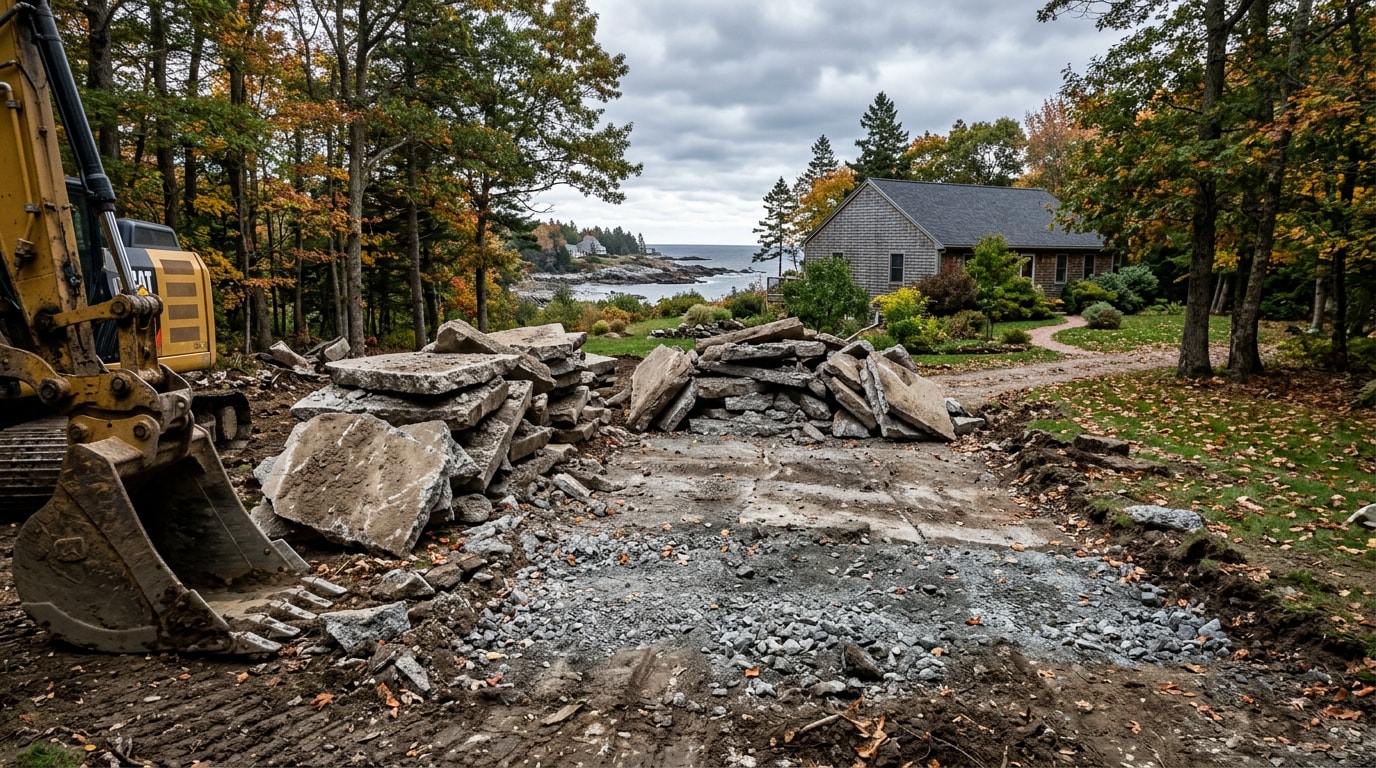
- Breaking and loading - hydraulic breakers or jackhammers reduce the slab to manageable pieces for removal.
- Haul-off and recycling - debris goes to a licensed facility, with crushed concrete often recycled as fill or base material.
Our crews see the same pattern across Hancock County jobs: a slab that looks fine on the surface but has a sunken edge or hollow sound under a hammer tap, which usually means the base failed years before the concrete did. Reliable excavation services after demolition correct that base problem instead of just pouring new concrete over the same issue.

Safety Standards Every Concrete Demolition Crew Should Follow
Concrete demolition carries three recurring hazards: silica dust, unexpected rebar during breaking, and buried utility strikes. Each needs a specific control, not general caution.
Controlled breaking with hydraulic tools, wet-cutting methods, and marked exclusion zones limit flying debris and airborne dust compared to uncontrolled DIY breaking. OSHA's construction standard for respirable crystalline silica requires employers to use engineering controls, such as water delivery systems on saws, to keep worker exposure below the permissible limit. The OSHA silica standard for construction lays out the specific equipment and work-practice requirements licensed demolition crews are expected to follow on every job, not just the big ones.
If a quote doesn't mention dust control or utility locating at all, that's worth asking about before you sign anything.
Why Hancock County's Freeze-Thaw Climate Changes the Job
Maine's building code generally requires footings and foundations to be placed roughly 48 inches below grade to get below the frost line, among the deepest standards in the continental United States. That same frost penetration is what destroys driveways and patios that were poured on a shallow or poorly compacted base.
Water seeps into hairline cracks, freezes, and expands. Each cycle widens the crack a little more until a slab that looked solid in October is heaving and spalling by April. The Federal Highway Administration's research on air entrainment confirms that a properly spaced air-void system in the concrete mix is what actually relieves that internal pressure; without it, repeated cycles degrade the slab faster than the same mix would fail in a milder climate, as detailed in FHWA's tech brief on air entrainment and concrete durability.
Durable concrete replacement in this county accounts for that cycle with adequate base depth, drainage, and air-entrained mix design rather than just matching what was there before.

If drainage was part of the original failure, pairing demolition with drainage system installation keeps the replacement slab from repeating the same freeze-thaw damage.
Permits, Disposal, and Recycling Rules in Maine
Permit requirements in Maine are not uniform statewide, which trips up a lot of homeowners. The Maine Uniform Building and Energy Code is mandatory only in municipalities over 4,000 residents; smaller Hancock County towns may opt in or have no local enforcement at all. You can check your town's status through the Maine building and energy code program before assuming a permit is or isn't needed.
Small residential flatwork like a driveway or patio often doesn't need a permit on its own, but sidewalk or curb-cut work in the public right-of-way usually does, and shoreland zoning adds another layer near the water. Confirm with your specific town office.
Once the slab is out, disposal matters too. Maine classifies broken concrete as construction and demolition debris, which must go to a licensed solid waste facility rather than being buried or burned on-site. Many contractors crush and recycle clean concrete as fill or base material, which cuts disposal costs and keeps material out of the landfill.
How to Choose the Right Concrete Demolition Contractor
Not every excavator or paving crew is equipped to handle demolition correctly. Before you book a job, check for these four things:
- Active licensing and insurance - ask to see proof, not just a verbal confirmation.
- Concrete-specific experience - general demolition and concrete breaking require different equipment and technique.
- A written scope covering cleanup - demolition and haul-off should be one line item, not two separate surprises.
- A real answer on permits and disposal - a contractor who shrugs off this question is leaving you to sort it out later.
Get a free estimate once you've confirmed those four points, so the quote you get back is actually comparable to others.
When Demolition Sets Up a Bigger Project
Removing old concrete is often the first move toward fixing what's underneath, whether that's a cracked sub-base, poor drainage, or a buried utility line that needs access. This is especially common ahead of septic work, where a driveway or patio sits directly over a planned septic site preparation area.
Demolition before renovation gives repair crews clean access to the real problem instead of patching the surface and hoping the base holds. For material haul-off and new base rock once the old slab is gone, gravel delivery and installation is usually the next call. If the project is part of a larger build, our guide on GWB in construction terminology in Hancock County breaks down more of the vocabulary contractors use during permitting and framing.

We work across the county, from Ellsworth and Bar Harbor to Bucksport and Castine. Visit our Hancock County, ME service area page to confirm coverage for your town, or start at our homepage for the full list of services.
FAQ
How much does concrete removal cost per square foot?
Concrete removal typically costs $2 to $6 per square foot, depending on slab thickness, reinforcement, site access, and disposal fees. Reinforced slabs with rebar or wire mesh land at the higher end.
Do I need a permit for concrete demolition in Hancock County?
It depends on your town. Small residential flatwork like a driveway or patio often doesn't require a permit, but sidewalk or curb-cut work in the public right-of-way usually does, and MUBEC enforcement varies by municipality population. Confirm with your town office before scheduling work.
How long does a typical concrete removal project take?
Most residential driveway or patio removals take one to two days from breaking to haul-off, depending on slab size and site access. Larger foundation removals or jobs requiring extensive utility locating can take longer.
Can I remove concrete myself to save money?
Small, thin, unreinforced slabs can sometimes be broken up with rented equipment, but reinforced concrete, buried utilities, and silica dust exposure make most jobs a poor DIY fit. A miscalculated utility strike or an unmarked rebar grid can turn a weekend project into an expensive repair.
How can I choose the best contractor for my project?
Verify active licensing and insurance, ask about concrete-specific experience, and confirm they handle both demolition and site cleanup in one scope. Contact us for a written estimate that covers all four.
Can I save money by recycling or deconstructing the concrete?
Deconstruction, salvaging reusable materials before demolition, applies more to structures than pure concrete slabs. Crushing and recycling the broken concrete on-site for fill or base material can still lower disposal costs and reduce your overall project price.