Green home builders in Bucksport, ME promise lower bills and a tighter house, but the label alone doesn't guarantee either one. A well-built energy-efficient home has to hold up against Penobscot Bay winters and salt air, not just meet a marketing checklist. This guide breaks down the certifications, real cost data, rebates, and site conditions that actually determine whether a "green" build performs or just sounds good on paper.
What "Green" Actually Means for a Bucksport Build
In practical terms, a green build means tighter construction, climate-matched insulation, and mechanical systems sized to handle Maine winters without overworking. That shows up as a lower heating bill, steadier room-to-room temperatures, and fewer cold spots near windows and doors.
None of that happens automatically just because a builder uses the word "sustainable" in a proposal. It happens because of specific, verifiable choices made during design and framing, which is why certifications and testing exist in the first place.
Certifications That Actually Prove a Green Build
Certifications exist so buyers don't have to take a builder's word for it. Each one verifies a different bar of performance, and knowing the difference matters before you compare quotes.
| Certification | Verifying Body | What It Actually Checks |
|---|---|---|
| ENERGY STAR Certified Homes | U.S. EPA | Third-party rater inspection of insulation, HVAC sizing, and air sealing |
| LEED for Homes | U.S. Green Building Council (USGBC) | Points-based scoring across energy, water, materials, and indoor air quality |
| Passive House | Passive House Institute / PHIUS | Strict airtightness targets confirmed by blower-door testing |
The EPA first offered the ENERGY STAR label for new homes in 1995, and the program created a national benchmark for superior energy efficiency in homebuilding, built on third-party inspections by home energy raters. It's a floor, not a ceiling, for performance.
LEED for Homes works differently. It uses a points-based checklist where projects earn points across energy, water, indoor environmental quality, and material choices, with points adding up to four certification levels: Certified, Silver, Gold, and Platinum. A builder claiming "LEED-certifiable" work should be able to tell you which tier they're actually targeting and why.
Passive House sits at the strict end. It demands verified airtightness, not just modeled estimates, which is why it suits buyers chasing near-zero energy bills but comes with a longer design timeline than a standard ENERGY STAR build.
The Building Blocks of a High-Performance Home in Midcoast Maine
A high-performance home is the technical foundation under every green claim: airtight construction, right-sized mechanicals, and tested results instead of guesses.
Effective insulation and air sealing. Spray foam and cellulose are the two most common choices in Maine builds, each with different R-value and air-sealing performance depending on placement. Gaps in coverage, not the material itself, are usually what cause cold spots and high bills.
High-performance windows. Low-E coatings and improved frame design cut heat loss in winter and block UV damage in summer. Triple-pane windows push that performance further on sites facing exposed coastal wind, which is common around Bucksport and the Penobscot River.
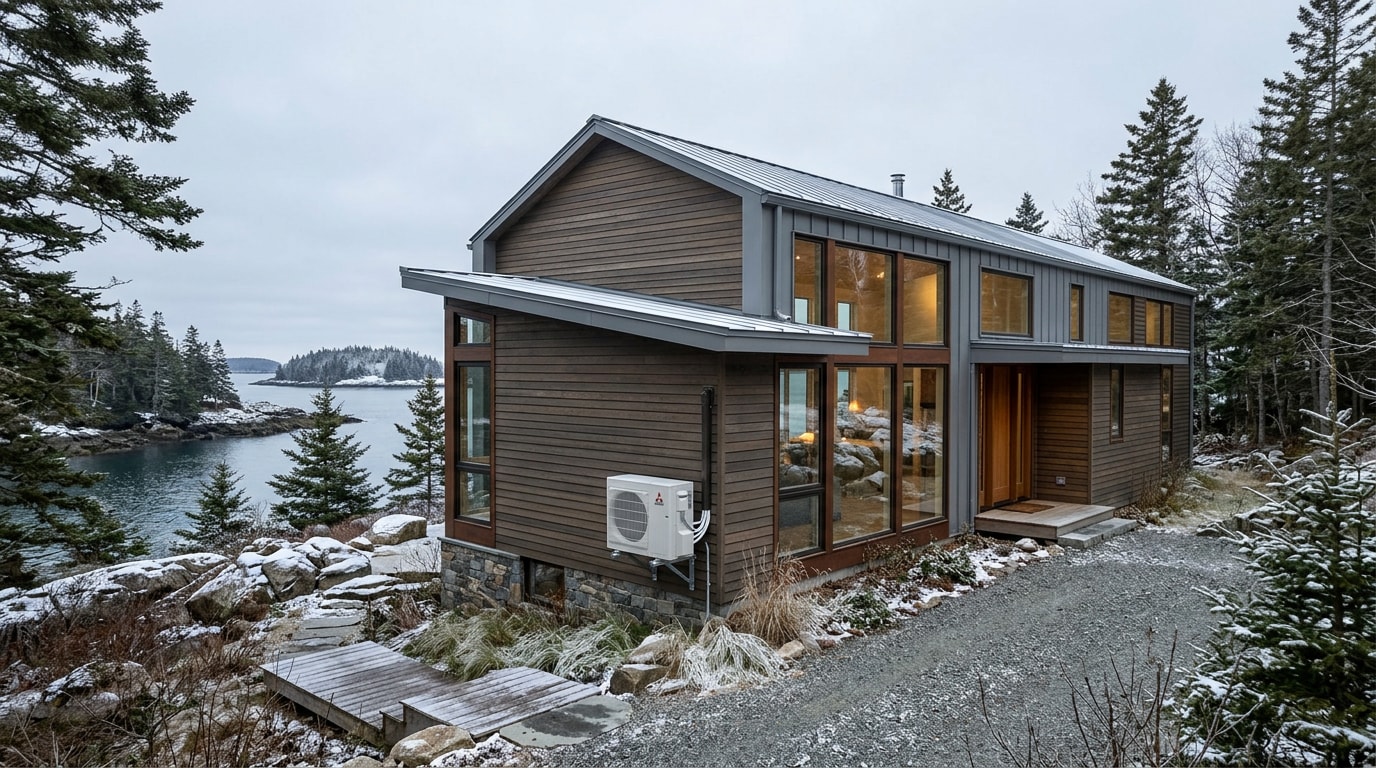
Efficient heating and cooling equipment. Over 200,000 heat pumps have been installed in Maine homes and businesses, and they are now more common than oil heat in new homes. That's not a marketing claim, it's a regional construction trend, and it's why most green builders now spec heat pumps as the default rather than the upgrade.
Lighting and appliances. ENERGY STAR-rated fixtures and appliances are a lower-cost way to round out a build. They won't carry a project on their own, but paired with a tight envelope, the savings compound over the life of the home.

The Site Work Most Buyers Never Ask About
Here's what most green-building guides skip entirely: none of the insulation, windows, or HVAC specs matter if the ground under the house isn't handled correctly. A poorly drained lot pushes moisture into a tight envelope, which undermines the exact air quality and durability benefits a green build is supposed to deliver.
In our site-prep work across Hancock County, the efficiency complaints we see most often trace back to grading and drainage decisions made before the foundation was poured, not the insulation spec. A tight building envelope with water pooling against the foundation is a recipe for moisture problems, not comfort.
Three site conditions worth asking your builder about directly:
- Septic and drain field placement. Poor layout can force compromises on orientation or foundation design later. Our septic system design consultation and septic site preparation work happens before the foundation plan is finalized for exactly this reason.
- Grading and drainage. Water needs a planned path away from the structure. See our drainage system installation work for how this gets handled on coastal Maine soils.
- Excavation and site preparation. Ledge, clay, and frost depth all affect foundation design and cost. Our excavation services team deals with this on nearly every Bucksport-area lot.
If you're planning a build in the area, our custom home building process guide for Bucksport, ME walks through how site work and design decisions fit together from permit to move-in.
What It Costs to Build Green in Bucksport, ME
Cost premium estimates vary widely depending on which study you read and which certification tier you're targeting, so treat any single number with some skepticism.
| Performance Target | Typical Cost Premium | Source |
|---|---|---|
| Moderate sustainable design (roughly LEED Silver-equivalent) | ~1% to 2% | Industry cost-of-green-building analysis |
| High-end certification (LEED Platinum-equivalent) | Up to ~10% | Industry cost-of-green-building analysis |
| General "green" builds, builder-reported average | Most commonly 5% to 10% | NAHB SmartMarket Brief |
Most studies using this methodology report average green premiums in the range of 1% to 2% to achieve a moderate level of sustainable design, generally equivalent to a LEED Silver rating.
Costs can reach almost 10% above conventional construction at the highest LEED certification level. Separately, among builders who believe green building involves a cost premium, the highest percentage put that premium between 5% and 10% , according to NAHB's Green Single Family and Multifamily Homes survey.
That premium is usually offset over time by lower utility bills, and in some markets by resale value. A Bay Area study, for example, found that green-labeled homes sold for 2.19% more on average than comparable non-labeled homes; results elsewhere have ranged from roughly 3% to 6%. Maine-specific resale data is thinner, so treat that as a directional signal, not a guarantee.
How to Vet a Green Home Builder in Bucksport
Ask these questions before signing anything:
- What certifications does the builder actually hold (not just advertise)? Membership in USGBC or an ENERGY STAR Partnership is a floor, not proof of a finished result.
- Can they show a portfolio of completed, verified projects in the Midcoast/Hancock County area specifically, not just a statewide reputation?
- Do they perform blower-door testing to confirm air-sealing results, or do they estimate performance on paper?
- Who handles site prep and septic design, and do they coordinate that work before foundation plans are finalized?
- What's their timeline for design and planning before framing starts? Performance-focused builds need more upfront time than a standard build.
A glossy statewide portfolio means little if the builder doesn't regularly work in your specific soil, climate, and permitting conditions.
Who's Actually Building Green in the Bucksport/Midcoast Market
Not every builder on a statewide "best of" list realistically serves Bucksport, so confirm service radius before falling for a strong portfolio photo.
- Passive House specialists target strict airtightness and third-party verification.
Firms describing themselves as Certified Passive House Consultants root their work in modern building science , which suits buyers chasing near-zero energy bills but comes with longer design timelines.
- Net-zero-ready builders focused on Mid-Coast Maine exist specifically for this market.
Landicity Builders, for example, builds high-performance, highly engineered homes in Mid-Coast Maine and the surrounding locations.
- ENERGY STAR partner builders combine general custom home work with efficiency credentials, which can be a practical middle ground for buyers who don't need Passive House-level performance.
Before hiring any of them, confirm they build in your specific town, not just "Maine" broadly.

Rebates and Incentives for Energy-Efficient Homes in Maine
Efficiency Maine is the state's primary source of rebates for energy upgrades, and the amounts change based on household income.
| Upgrade | Low Income | Moderate Income | Any Income |
|---|---|---|---|
| Heat Pump Water Heater | $1,200 | $1,200 | $1,200 |
| Heat Pumps | $9,000 | $6,000 | $3,000 |
| Insulation / Air Sealing | $8,600 | $8,600 | $8,600 |
These figures come directly from Efficiency Maine's residential rebate program, and they apply whether you're retrofitting an existing home or building new with qualifying equipment. Rebate amounts and eligibility rules change, so confirm current figures before budgeting around them.
About This Guide
This guide is maintained by the site work and construction team at MPS LLC, who handle excavation, septic design, and drainage work for custom and energy-efficient home builds throughout Bucksport, ME and Hancock County. We don't frame houses or install insulation ourselves, but we're on the ground before the foundation goes in on most green builds in this region, which is where a lot of efficiency problems actually start or get avoided.
If you're planning a build in Bucksport and want to talk through site conditions, septic design, or drainage before you finalize plans with a builder, get a free estimate and we'll walk through what your lot needs.
FAQ
Does it cost more to build a green home?
Usually, yes, but the premium varies by target. Industry studies put a moderate sustainable build at roughly a 1% to 2% premium, while higher certification tiers can reach close to 10%. NAHB's builder survey found most who report a premium estimate it between 5% and 10%. Higher upfront costs are generally offset over time through lower utility bills.
What certifications should energy-efficient home builders have?
Look for ENERGY STAR Partnership, LEED for Homes experience, or Passive House certified training. Each represents a different performance bar, so ask which standard a specific project is actually being built to rather than assuming all certifications mean the same thing.
What's the difference between LEED, ENERGY STAR, and Passive House?
ENERGY STAR is a baseline efficiency label verified by a third-party rater. LEED is a broader points-based system covering energy, water, and materials across four tiers. Passive House is the strictest, requiring verified airtightness through blower-door testing rather than modeled estimates.
Are there rebates for building a green home in Bucksport, ME?
Yes. Efficiency Maine offers rebates for heat pumps, heat pump water heaters, and insulation/air sealing, with amounts varying by household income. These apply to both retrofits and qualifying new construction.
What questions should you ask a potential green home builder?
Ask about their experience with energy-efficient builds specifically, request references from local projects, and confirm whether they perform blower-door testing to verify results. Also ask who handles site prep and septic design, and whether that work is coordinated before foundation plans are finalized.
How long does it take to build an energy-efficient home?
Most energy-efficient custom homes take roughly 6 to 18 months depending on size and complexity. Performance-focused builds often need extra time upfront for design and planning, since air sealing details and equipment sizing have to be worked out before framing starts.